What Is a Dessert Popular in India but Not From India?
 Feb, 10 2026
Kulfi Authenticity Checker
Test your kulfi against the traditional criteria from the article. Authentic kulfi has specific characteristics that distinguish it from Western ice cream and modern fakes.
Key Authentic Features: Dense texture, pale yellow color, cardamom flavor, cone-shaped mold
Authenticity Result
Did you know? Kulfi was brought to India by Mughal chefs from Persia (1500s), who adapted their frozen milk dessert with local ingredients like cardamom and saffron.
Walk into any sweet shop in Mumbai, Delhi, or Chennai, and you’ll see rows of colorful, creamy treats. Gulab jamun, jalebi, rasgulla - these are the classics. But tucked between them, often right next to the peda and barfi, is something that looks like it belongs: kulfi. It’s thick, slow-churned, packed with cardamom and saffron, and sold on sticks like an ice cream bar. You’d think it’s Indian. But it isn’t.
Kulfi Isn’t Indian - It Came From Persia
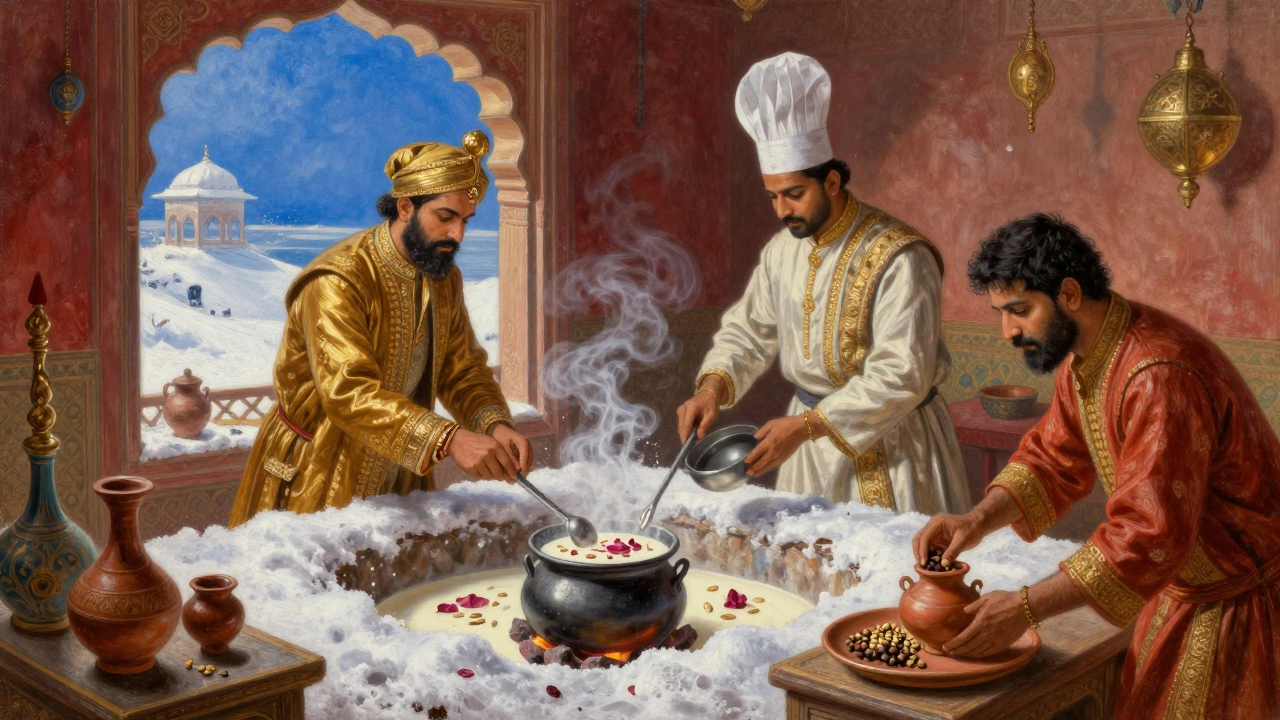
Kulfi is often called Indian ice cream. But that’s a mislabel. It didn’t evolve from traditional Indian milk sweets like rasgulla or kheer. It was brought over during the Mughal Empire, which ruled much of northern India from the early 1500s to the mid-1800s. The Mughals were descendants of Timur and Genghis Khan, with deep roots in Central Asia and Persia. Their court chefs brought with them a chilled milk dessert called sharbat-i-falak - a frozen milk mixture flavored with rosewater, nuts, and fruits.
This Persian dessert was adapted in India using local ingredients. Instead of rosewater, they used cardamom. Instead of imported nuts, they used almonds and pistachios grown in Kashmir. They replaced the Persian freezing method - which used snow and salt - with a clever trick: placing clay pots filled with sweetened milk into large, shallow containers of ice and salt. The ice melted slowly, freezing the milk from the outside in. The result? A dense, creamy, slow-melting treat that held its shape. That’s kulfi.
How Kulfi Differs From Western Ice Cream
Most people think of ice cream as light, airy, and whipped with air. Western ice cream uses churners that incorporate air as it freezes. That’s why a scoop of vanilla ice cream from a supermarket can be half air. Kulfi? No air. Ever.
Here’s how it works:
- Whole milk is simmered for hours - sometimes up to six - until it reduces to one-third its original volume. This concentrates the fat and sugar, giving kulfi its rich texture.
- Sugar, cardamom, saffron, and nuts are stirred in. No eggs. No stabilizers. No emulsifiers.
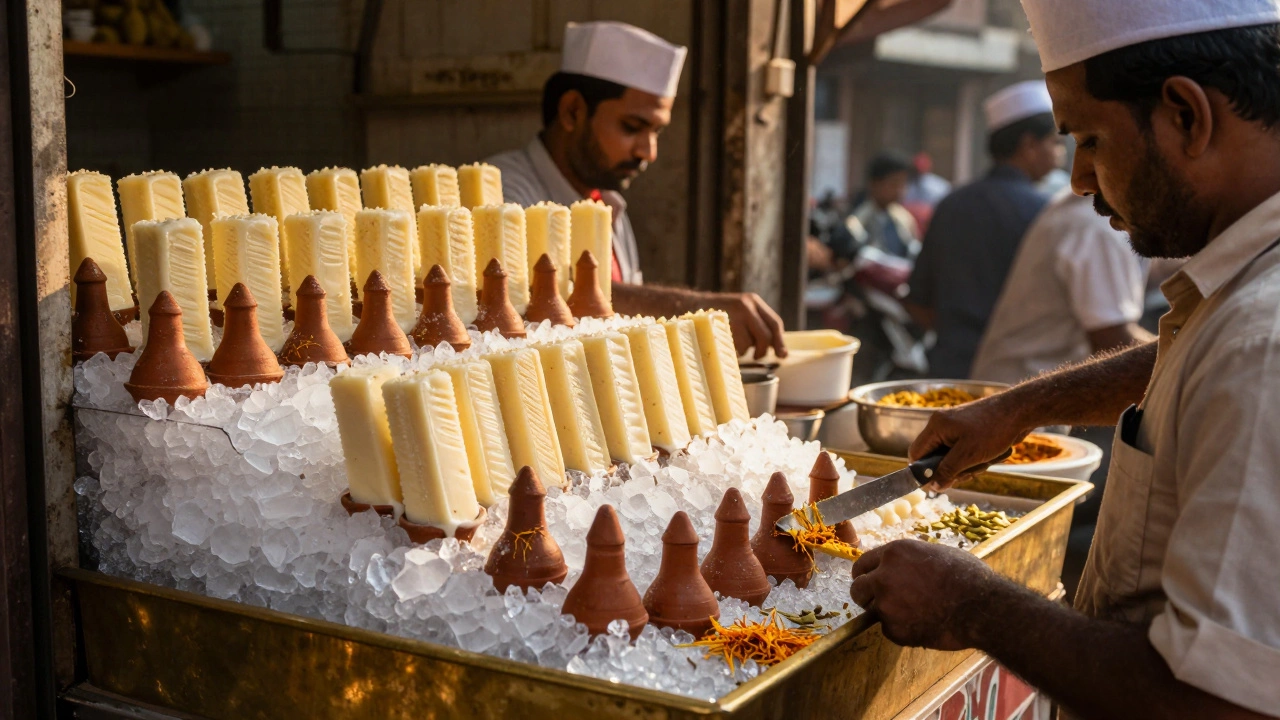
- The mixture is poured into small, narrow clay pots or metal molds.
- These are sealed and buried in a mixture of ice and salt for 6-8 hours. No churning. No air.
The outcome? A dessert that melts slowly, clings to the spoon, and tastes like pure, sweetened milk with a hint of spice. It’s not just frozen milk - it’s concentrated flavor. A single kulfi stick has about 200 calories, mostly from milk fat and sugar. Compare that to a typical ice cream bar, which has around 150 calories but far less substance.
Why Kulfi Took Root in India
India has a long tradition of dairy-based sweets. Milk, ghee, and paneer have been used in rituals and celebrations for centuries. But before the Mughals, there was no chilled dairy dessert. The hot climate made preservation hard, and freezing wasn’t practical.
Kulfi changed that. It was portable, shelf-stable (for a few hours), and could be sold on street corners. By the late 1800s, kulfi wallahs - vendors carrying brass pots on their heads - were common in Lucknow, Delhi, and Agra. They’d serve it with chopped pistachios and a sprinkle of rosewater. It became a summer ritual.
Today, you’ll find kulfi in every Indian city. But it’s not called by its Persian name. It’s not labeled as a foreign import. It’s just… kulfi. And in India, that’s enough.
Modern Versions and Misconceptions
Now, you can buy kulfi in flavors like mango, chocolate, and even coffee. Some brands sell it in plastic cups, others in cones. But the traditional version - made with full-fat milk, slow-reduced, and frozen in molds - is still the most loved.
Many think it’s a regional specialty from North India. But it’s eaten everywhere. In Kerala, you’ll find it with coconut. In Bengal, it’s served with rabri. In Pune, street vendors add falooda noodles. Yet none of these versions change its origin. It’s still a Persian creation that India made its own.
Even today, most Indians don’t know kulfi came from Persia. It’s not taught in schools. It’s not on restaurant menus as an imported dish. It’s just dessert. And in a country with over 2,000 years of culinary exchange, that’s not unusual. Think of how many things we now call Indian - like potatoes, tomatoes, or chili peppers - that originally came from the Americas. Kulfi is just one more.

How to Tell If You’re Eating Real Kulfi
If you’re trying kulfi for the first time, here’s how to spot the real deal:
- Texture: It should be dense, almost chewy. If it melts too fast, it’s likely regular ice cream with flavoring.
- Color: Traditional kulfi is pale yellow or off-white. Bright pink or blue versions are usually artificial.
- Flavor: Cardamom should be the star. If it tastes like vanilla or strawberry, it’s a modern twist.
- Shape: It’s usually sold in cone-shaped molds. If it’s round like a scoop, it’s probably not authentic.
Real kulfi doesn’t need fancy packaging. It’s often sold from a metal container kept in ice. The vendor cuts a slice with a knife and hands it to you on a stick. That’s the real experience.
Why This Matters
Kulfi isn’t just a dessert. It’s proof that food doesn’t need a passport to belong. India didn’t invent it, but it transformed it. It took a Persian idea and made it deeper, richer, more aromatic. It didn’t replace local sweets - it joined them.
Today, when you bite into a kulfi, you’re tasting centuries of trade, empire, and adaptation. You’re tasting a dish that crossed borders, changed hands, and became something new. And in India, that’s not a foreign import. It’s home.
Is kulfi the same as ice cream?
No. Kulfi is denser, creamier, and contains no air. While Western ice cream is churned to incorporate air for a light texture, kulfi is slowly frozen in molds without churning. This gives it a solid, rich bite that melts slowly. A typical kulfi has about 200 calories per stick, compared to 150 for a standard ice cream bar - but kulfi delivers far more flavor and substance per bite.
Where did kulfi originally come from?
Kulfi traces its roots to Persia, where a frozen milk dessert called sharbat-i-falak was enjoyed by royalty. Mughal chefs brought this recipe to India during the 1500s and adapted it using local ingredients like cardamom, saffron, and Indian nuts. The freezing technique was also modified to use ice and salt in clay pots, creating the version we know today.
Is kulfi healthy?
Kulfi isn’t a health food, but it’s simpler than most ice creams. It’s made from whole milk, sugar, cardamom, and nuts - no artificial flavors, stabilizers, or emulsifiers. A single kulfi stick has about 200 calories, 8-10 grams of fat, and 20 grams of sugar. If you’re watching sugar, go for the plain version. Avoid flavored ones with food coloring or syrups.
Can I make kulfi at home without ice and salt?
Yes. If you don’t have access to ice and salt, you can freeze it in a regular freezer. Just pour the reduced milk mixture into small containers, cover tightly, and freeze for at least 6 hours. Stir it once or twice during the first hour to prevent large ice crystals. The texture won’t be as dense as the traditional version, but it’ll still taste delicious.
Why is kulfi so popular in India if it’s not Indian?
Because India has always absorbed and transformed outside influences. Kulfi didn’t need to be invented here to become Indian. It was adapted using local ingredients, sold by local vendors, and eaten during local festivals. Over 400 years, it became part of daily life - from street corners to wedding feasts. Today, no one thinks of it as foreign. It’s just dessert.